
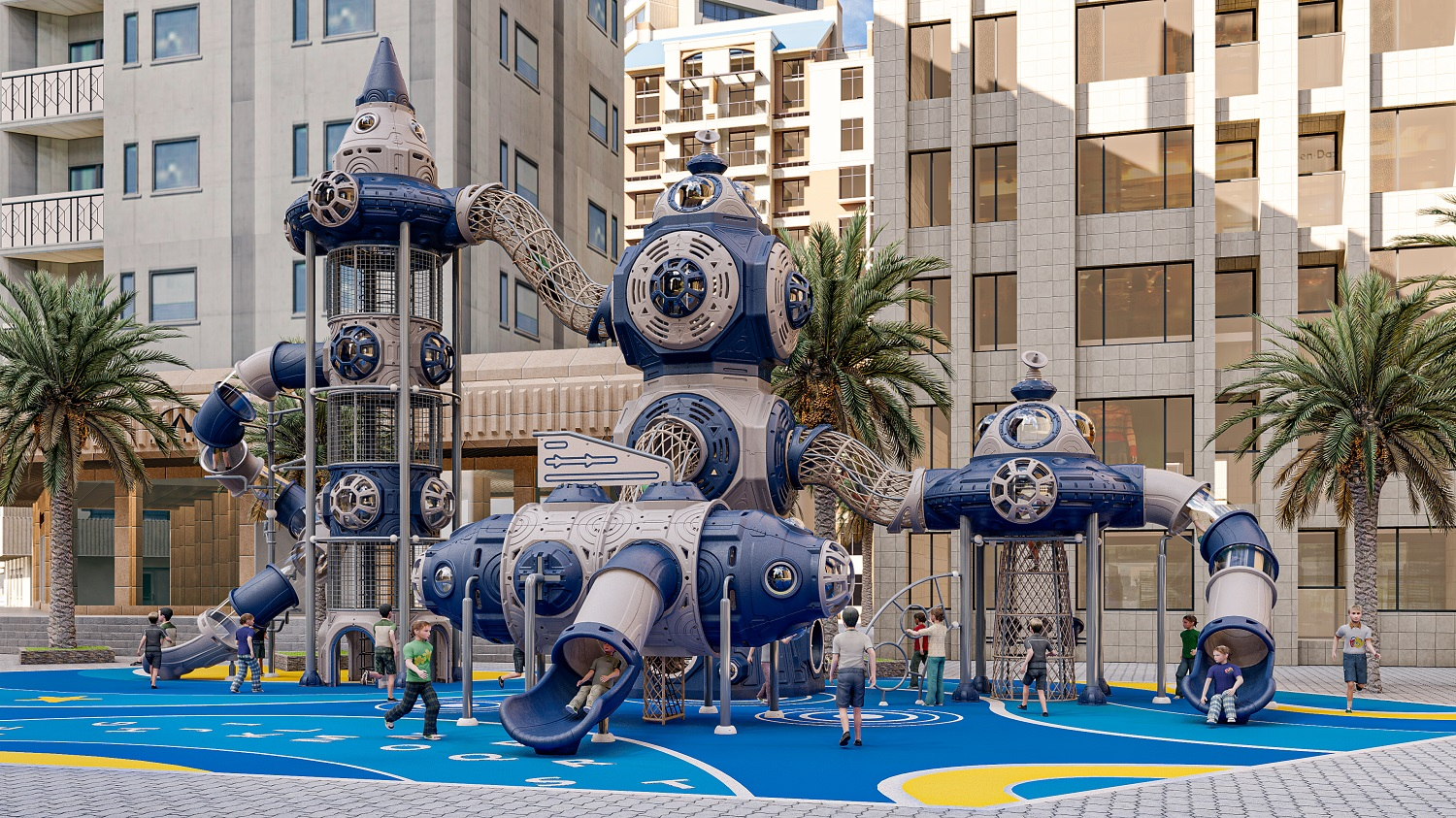
When it comes to designing a stimulating public play space, it takes much more than just buying some play equipment. It involves a sophisticated consideration from both an engineering and a psychological point of view. While managing large-scale municipal projects at Baiheplay, I have identified that successful parks address safety concerns as a dynamic, ongoing system rather than a static checklist. For example, in a recently revitalized urban coastal park, we had to mitigate high corrosion from salt mist alongside heavy pedestrian traffic. The answer was not just any play equipment; it was a well-designed children playground that combined material science with a spatial planning paradigm. In this article, I will outline how we respond to these challenges, ensuring that every children playground we create remains a joyful and safe sanctuary for the community.
Strategic Site Assessment and Risk Mitigation
No bolt can be fastened without a professional children playground plan starting with a detailed site assessment. Our planners focus on potential environmental threats and work with engineers to manage subterranean utilities and traffic flow issues. In a recent public park project, we strategically set the children playground area back 30 meters from the road, utilizing natural raised earth mounds and decorative fencing as "booster barriers" to prevent children from spontaneously "bolting" toward traffic. This level of commitment to safe, well-designed public facilities is what builds Trustworthiness. We also mitigate invisible risks, such as "contact burns," by choosing shaded locations for stainless steel slides. We assess and implement safety strategies even when the risks are outside the child’s immediate awareness, ensuring the children playground is secure by design.
Adhering to Global Safety Standards (ASTM & EN1176)
Safety is the absolute priority for any children playground. Every Baiheplay product is rigorously tested and certified against ASTM F1487 and EN1176 safety standards. Recently, a customer requested a custom, ultra-tall climbing tower for a signature city park. To ensure total safety, our engineering team performed a complete redesign of the internal entanglement zones and fall protection clearances to ensure 100% compliance with safety gap regulations. Designing a custom children playground requires a deep understanding of physics, specifically regarding finger entrapment and head/neck entrapment. To ensure the children playground equipment is risk-managed, our manufacturing team uses specialized probes to simulate the movement of a child during peak hours, guaranteeing that the children playground remains a compliant and protected environment for all users.
Non-Toxic and Climate-Resilient Material Selection
A major innovation we have developed at Baiheplay is the use of "Climate-Resilient Materials" to solve the problem of environmental degradation. Public children playground equipment is at risk of constant exposure to UV rays and humidity. To solve this, we employ high-grade LLDPE (Linear Low-Density Polyethylene) with a UV-stabilizer rating of 8, which is a significant improvement over standard industry materials. In a high-altitude children playground installation where UV exposure was extreme, our choice of material ensured the colors were maintained and the plastic remained pliable over a long period. Furthermore, the use of 304 stainless steel and double-galvanized posts in the children playground structure ensures that integrity is never compromised by rust, which remains the number one cause of hidden structural failures in public children playground facilities.
Advanced Impact-Attenuating Surfacing Solutions
The most important and often most expensive part of the safety equation for a children playground is the surfacing of the "Fall Zone." For large municipal parks, we advise a dual-layer Poured-in-Place (PIP) rubber system. This solution consists of a base "cushion layer" made of recycled SBR and a top wear layer of EPDM. For each children playground project, we compute the "Critical Fall Height" (CFH). We base the thickness of the rubber surfacing on the maximum G-force zones of the specific equipment. For a climbing frame that is 2.5 meters high, the surfacing must be precisely engineered to absorb impact. This data-backed approach guarantees compliance with HIC (Head Injury Criterion) tests, providing essential peace of mind to city officials and the parents using the children playground.
Social Flow and Age-Appropriate Zoning
The factor of "age collision" is a common pitfall in the design of public children playground spaces. To minimize this, Baiheplay recommends the intentional separation of toddler (ages 2-5) and school-aged (ages 5-12) play zones. In one of our recent suburban park projects, we designed a "Central Observation Hub" for parents, which provided a natural divider between different activity levels. On one side, the children playground focused on sensory play and small slides for younger children; on the opposite side, we installed high-energy cable rides and complicated climbing nets. This strategic zoning ensures a 10-year-old’s high-speed play does not place a toddler’s first steps at risk. An inclusive children playground must respect the developmental milestones of all children simultaneously.
Universal Design and Accessibility Integration
True safety means everyone feels included in the children playground. In alignment with ADA (Americans with Disabilities Act) and global inclusion guidelines, our designs incorporate "Flush-Transition" surfacing. This removes the "lip" or edge that typically separates the grass and the play area, allowing wheelchairs to glide onto the rubber surfacing without obstruction. We have successfully embedded "Inclusive Whirls" and "Wheelchair-Accessible Gliders" into many public children playground projects. Our experience suggests that when a children playground is designed for the most vulnerable users, it becomes safer for everybody. By removing physical obstacles and trip hazards, we keep the children playground inclusive and safe for children of all physical abilities.
Maintenance Protocols and Long-Term Reliability
The "Solution" for a children playground goes far beyond the grand opening. To maintain Trustworthiness, a children playground requires a dedicated maintenance lifecycle. We provide our clients with a digital "Maintenance Audit Kit" that guides them through checking bolt torque, identifying surface wear, and mitigating vandalism. In one of our long-term partnership projects, a potential failure was avoided because a technician caught a worn swing bearing during a routine audit. Designing a children playground means planning for the next 10 to 15 years. Quality public spaces are sustained through proactive care, ensuring the children playground stays just as safe on day 3,000 as it was on day 1.
Table of Contents
- Strategic Site Assessment and Risk Mitigation
- Adhering to Global Safety Standards (ASTM & EN1176)
- Non-Toxic and Climate-Resilient Material Selection
- Advanced Impact-Attenuating Surfacing Solutions
- Social Flow and Age-Appropriate Zoning
- Universal Design and Accessibility Integration
- Maintenance Protocols and Long-Term Reliability


